
Bitcoin’s security model is facing a new and increasingly complex challenge: the rapid development of artificial intelligence.
As frontier AI models become capable of analyzing code, discovering vulnerabilities and automating sophisticated technical tasks, the same technology that could help protect Bitcoin may also give attackers a powerful new advantage.
This growing concern has prompted the Bitcoin Policy Institute (BPI) and a group of major cryptocurrency companies to call for greater access to advanced AI systems for Bitcoin and open-source developers.
But the issue goes beyond simply asking AI companies to provide better tools. It raises a much bigger question for the cryptocurrency industry: what happens when AI-powered attackers move faster than the developers responsible for defending the infrastructure?
The AI Security Gap
Bitcoin Core and other major open-source projects depend heavily on independent developers and security researchers. Unlike large technology companies, many of these developers do not have direct access to the latest frontier AI models or specialized cybersecurity programs.
At the same time, advanced AI systems are becoming increasingly useful for offensive security research.
An attacker with access to a powerful model can potentially analyze large repositories, identify suspicious code, search for vulnerabilities and accelerate the development of sophisticated attack techniques.
Defenders, meanwhile, may encounter restrictions when attempting to perform similar security research with publicly available AI systems.
This creates a potentially dangerous asymmetry.
If the most capable AI tools become primarily available to attackers, the open-source ecosystem could find itself defending increasingly complex infrastructure with inferior resources.
Bitcoin Is Too Valuable to Ignore
The stakes are particularly high for Bitcoin.
The Bitcoin network and its surrounding open-source infrastructure protect enormous amounts of economic value. A vulnerability in critical software could potentially affect exchanges, wallets, custodians, businesses and individual users.
The BPI and its supporters argue that security researchers working on this infrastructure should therefore be treated differently from ordinary AI users.
Rather than giving unrestricted access to everyone, AI companies could establish trusted-access programs for verified developers and cybersecurity researchers working on critical open-source projects.
Such a system could allow AI companies to maintain safety controls while giving legitimate defenders access to more powerful capabilities.
Crypto Hacks Show the Problem Is Getting Worse
The timing of the proposal is significant.
Cryptocurrency security incidents continue to result in substantial financial losses. According to DeFiLlama data, more than $634 million was stolen from crypto platforms in April 2026 alone, highlighting the scale of the threat facing the industry.
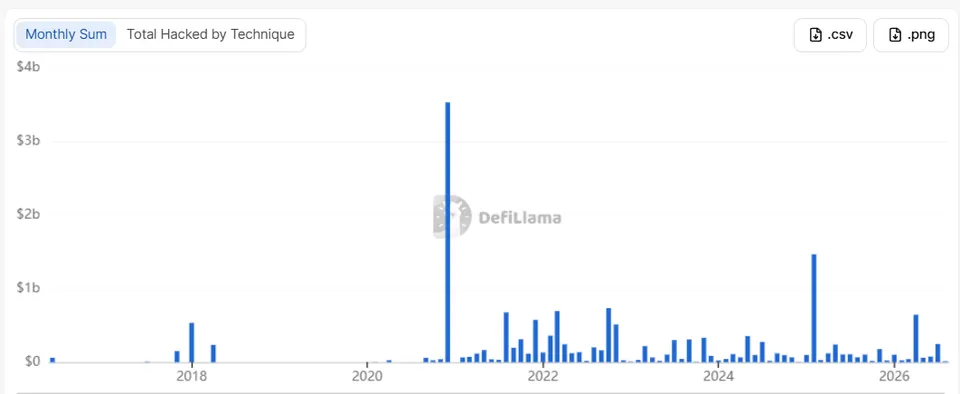
Meanwhile, AI-assisted vulnerability discovery is becoming increasingly sophisticated.
The emergence of models such as Claude Opus 4.8 and ChatGPT 5.5 has intensified discussions about how quickly AI can transform cybersecurity research. Immunefi CEO Mitchell Amador has even described the situation as a potential “vulnerability apocalypse” for crypto.
The concern is not necessarily that AI will make Bitcoin less secure.
In the right hands, it could make Bitcoin far more secure.
The real danger is that the technology could develop faster than the defensive capabilities available to the people maintaining the ecosystem.
The Next Battle May Be Human vs. AI-Assisted Human
Bitcoin’s security has historically depended on cryptography, decentralization, peer review and a global community of developers.
AI introduces another layer.
The future security race may increasingly be determined not only by who has the best programmers, but by who has access to the most capable AI systems.
That means the debate surrounding frontier AI access could become an important issue for the entire cryptocurrency industry.
For Bitcoin developers, early access to advanced AI models could provide a valuable opportunity to discover vulnerabilities before attackers do.
For AI companies, trusted access could offer a way to support cybersecurity without completely removing safety restrictions.
And for the broader crypto ecosystem, the question may ultimately be simple:
If AI is becoming one of the most powerful tools for finding vulnerabilities, should the people defending Bitcoin be given access to the same technological advantage as those trying to break it?