
The growing use of artificial intelligence agents to make payments is challenging the assumption that cryptocurrencies will eventually become the dominant financial infrastructure for autonomous software. While stablecoins offer advantages for automated, low-value transactions, traditional payment networks are already adapting their systems to accommodate AI-driven purchases.
The Wall Street Journal reported on Nov. 19 that AI agents are beginning to use credit cards to purchase goods and services on behalf of consumers. Banks and payment providers are now working to support this emerging form of commerce, suggesting that blockchain-based payments may face more competition than the crypto industry initially anticipated.
The development prompted crypto trader and 1000x podcast co-host Jonah Van Bourg to question whether blockchain has a meaningful role in the future of AI payments. He argued that AI agents are unlikely to adopt crypto payment infrastructure, suggesting that blockchain’s remaining applications will largely involve stores of value, privacy and ledger management.
However, industry experts believe the outcome will depend largely on the type of transaction being processed. David Krause, professor emeritus of finance at Marquette University, told Magazine that conventional payment cards remain useful for ordinary purchases but are poorly suited to extremely small payments.
Credit card networks were designed around human spending habits, where transactions typically involve amounts large enough to justify processing fees. When an AI agent needs to pay fractions of a cent for an individual API request, fixed transaction costs can become disproportionately expensive. Stablecoins could therefore offer a more practical alternative for machine-to-machine payments.
Traditional payment networks retain an advantage in consumer commerce
For transactions involving familiar online purchases, credit cards already have an established position. AI agents booking flights, reserving accommodation or ordering groceries can use existing payment infrastructure without requiring merchants to adopt an entirely new system.
Lewis Nurcombe, chief revenue officer at WalletConnect, explained that these transactions involve established merchants and consumer protections, including the ability to dispute payments through chargebacks.
Visa has also outlined how tokenization could make agent-driven purchases safer. Its research on agentic commerce describes a system in which AI agents receive permission to make payments without accessing the cardholder’s actual payment credentials. Spending restrictions can further limit which purchases an agent is authorized to complete.
These capabilities allow traditional payment providers to extend existing infrastructure into automated commerce while maintaining familiar security and dispute-resolution mechanisms.
Micropayments could create an opening for stablecoins
The situation changes when AI agents begin purchasing services directly from other software systems.
Future autonomous agents could repeatedly pay for computing resources, individual datasets, API requests and specific pieces of information. Such transactions may involve only a few cents or fractions of a cent, potentially occurring thousands of times without requiring individual human approval.
Aitor Argomaniz, CEO of AI payments company Nevermined, said conventional card processing becomes impractical when agents need to pay small amounts for individual API calls.
Stablecoins provide an alternative by allowing software agents to hold funds in digital wallets and execute payments programmatically. Transactions can settle on blockchain networks without requiring a traditional checkout process.
Nurcombe believes stablecoins are particularly relevant when payments are too small, frequent or international for conventional card systems to handle efficiently.
One example is the x402 protocol, which enables online services to request payment directly during an interaction. Instead of requiring subscriptions or manual checkout procedures, an AI agent can pay for a specific resource before accessing it.
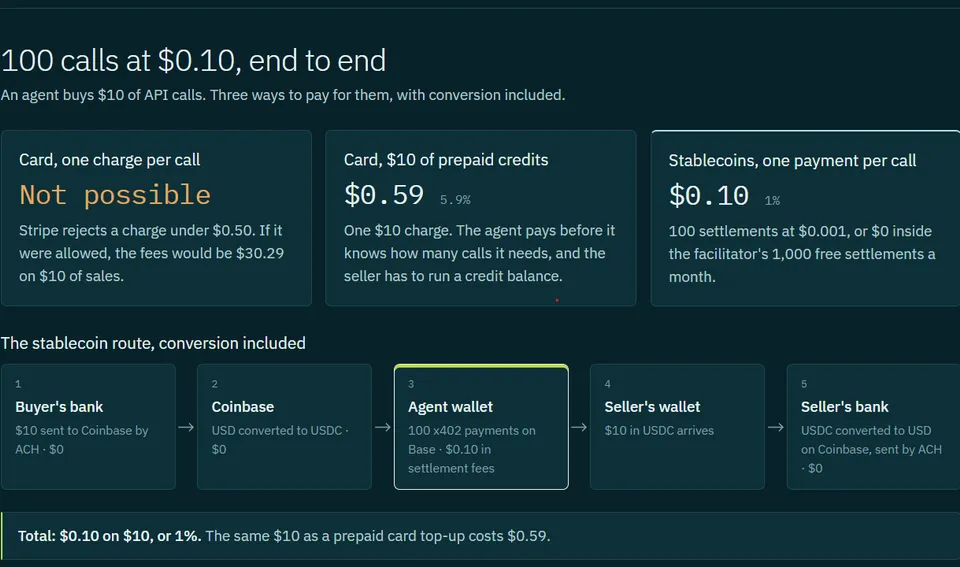
Nevermined illustrated the potential cost difference through a comparison involving 100 API calls priced at $0.10 each. According to the company, Stripe’s conventional payment infrastructure would reject individual charges below $0.50. By comparison, processing the same 100 payments through Coinbase’s x402 facilitator on Base would cost approximately $0.10 in total.
Nevertheless, blockchain payments are not automatically cheaper in every situation. Businesses could combine multiple micropayments into a single card transaction, while stablecoin systems introduce additional expenses involving infrastructure, custody, liquidity and currency conversion.
The Bank for International Settlements has also highlighted trading, conversion and withdrawal fees as potential obstacles to stablecoin adoption, particularly when users need to move between digital assets and local currencies.
Payment accountability remains a major obstacle
Beyond transaction costs, the expansion of autonomous payments raises questions about responsibility when an AI agent makes an incorrect or unauthorized purchase.
Krause believes identity verification and liability attribution will be more important than choosing between cryptocurrency and traditional payment networks. For example, if an agent books the wrong flight, consumers and merchants need a clear process for determining responsibility and resolving the dispute.
One potential safeguard involves giving AI agents access to separate wallets containing limited funds rather than allowing them to control a user’s entire financial balance.
WalletConnect is developing infrastructure that enables users to assign dedicated wallets to agents while retaining control over their remaining assets. According to Nurcombe, an agent’s maximum spending capacity can be restricted to the amount its owner has authorized.
However, spending limits alone cannot resolve every problem. They do not establish liability when an agent purchases the wrong service, makes an unauthorized transaction or is manipulated into sending funds to an unintended recipient.
Traditional financial institutions already have established relationships with consumers, merchants and regulators, alongside decades of experience managing payment disputes. These capabilities could give banks and card networks an advantage as automated commerce expands.
Krause expects major traditional financial institutions to remain influential, arguing that their access to funding and ability to connect conventional finance with blockchain infrastructure position them to offer hybrid payment solutions.
Argomaniz also expects credit cards and stablecoins to coexist for at least the next several years. Nevermined already supports both payment methods, reflecting the possibility that different transaction types will require different financial rails.
Blockchain could become infrastructure rather than the dominant payment system
The future of AI-driven commerce may not involve a direct victory for either cryptocurrency or traditional payment networks.
Even if stablecoins prove more efficient for machine-to-machine transactions, established financial companies could integrate blockchain technology into their existing services without transferring control of customer relationships to decentralized platforms.
In such a model, AI agents could continue interacting with familiar providers such as Visa and Mastercard, while blockchain networks operate behind the scenes to facilitate settlement and liquidity.
Mastercard’s acquisition of stablecoin infrastructure provider BVNK, announced at a potential value of up to $1.8 billion, illustrates how traditional payment companies are positioning themselves to connect fiat currencies with blockchain-based transactions.
Ultimately, cryptocurrencies may secure an important role in the emerging AI economy without becoming its primary consumer payment method. Blockchain could instead provide the underlying infrastructure for automated transactions, while banks and established payment networks retain much of the commercial relationship with users and businesses.