
Investor sentiment toward Bitcoin exchange-traded funds (ETFs) is showing early signs of improvement, but institutional capital has yet to return in a meaningful way, suggesting the cryptocurrency market may still be waiting for a stronger catalyst.
US-listed spot Bitcoin ETFs recorded $75.7 million in net inflows during the week ending July 17, extending their positive streak to two consecutive weeks. The latest figures followed $197.4 million in net inflows the previous week, bringing total ETF inflows for July to just over $200 million.
While the return of positive flows marks a notable shift after June’s heavy selling, the broader picture remains less encouraging. Spot Bitcoin ETFs suffered approximately $4.5 billion in net outflows during June, leaving total net flows for 2026 still deeply negative at around $5.2 billion.
Market analysts believe the recent inflows indicate that panic selling has begun to subside, but they stop short of calling it a full-scale return of institutional investors. Instead, they view the current activity as cautious positioning rather than renewed conviction.
Bitcoin has recovered toward the $64,000 level after retreating sharply in June, yet analysts argue that the rally remains technically fragile. According to Simon-Peter Massabni, Head of Business Development at XS.com, Bitcoin would need to break convincingly above the $65,000 to $65,500 resistance zone before a sustainable bullish trend could be confirmed.
The relatively modest ETF inflows reinforce that view. Although several consecutive sessions of positive fund flows are encouraging, they do not yet demonstrate the type of persistent institutional demand typically associated with the beginning of a long-term rally.
Wall Street’s outlook has also become more conservative. Earlier this month, Citigroup significantly revised its expectations for Bitcoin ETFs, lowering its 12-month inflow forecast from $10 billion to zero after weaker-than-expected demand. The bank also reduced its 12-month Bitcoin price target from $112,000 to $82,000, reflecting increased uncertainty over the pace of institutional adoption.
Despite the cautious outlook, analysts emphasize that Bitcoin’s long-term investment case has not fundamentally changed. Instead, the market appears to be lacking a major catalyst capable of attracting sustained institutional capital. Until that catalyst emerges, intermittent ETF inflows may provide temporary support but are unlikely to drive a lasting breakout.
Bloomberg ETF analyst Eric Balchunas also noted that Bitcoin ETFs may be following a path similar to that of gold ETFs during their early years.
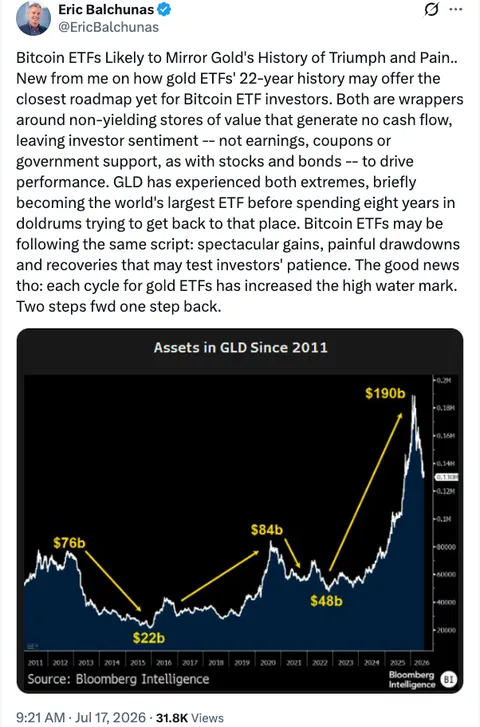
Both asset classes experienced rapid initial adoption before entering prolonged periods of consolidation, volatility, and eventual recovery. If history repeats itself, Bitcoin ETFs could continue to experience cycles of sharp gains and corrections, with each cycle gradually establishing higher long-term price levels.
For now, the latest ETF inflows suggest that confidence is stabilizing rather than accelerating. Whether institutional investors return in force will likely depend on stronger macroeconomic conditions, renewed capital inflows, or a decisive technical breakout that restores broader market confidence.