
On-Chain Metrics Flash Rare Bottom Signal as Long-Term Investors Begin Accumulating
Beyond the realized profit and loss ratio, several additional on-chain indicators are beginning to align with a classic market-bottom structure. While price action remains volatile, blockchain data suggests that selling pressure may be gradually shifting from panic-driven capitulation toward long-term accumulation.
Historically, Bitcoin has rarely produced a single indicator capable of calling the exact bottom. Instead, major reversals have emerged when multiple independent metrics simultaneously entered historically oversold territory—a pattern that appears to be developing once again.
Capitulation Appears to Be Nearing Exhaustion
One of the defining characteristics of bear-market bottoms is the transfer of Bitcoin from weaker hands to long-term holders.
During periods of heavy losses, short-term investors often sell at significant discounts as fear dominates decision-making. Long-term holders, by contrast, typically absorb that supply, believing the market is undervaluing Bitcoin’s future potential.
Recent blockchain activity suggests this process is already underway.
The combination of realized losses, subdued trading activity, and increasing long-term wallet balances indicates that experienced investors are quietly accumulating while retail participation remains limited. Similar accumulation patterns were observed following the 2015 bear market, the COVID-19 crash in 2020, and the aftermath of the FTX collapse in late 2022.
Although accumulation alone does not guarantee an immediate rally, it has historically marked the early stages of Bitcoin’s next expansion cycle.
Institutional Demand Could Become the Next Catalyst
The improving on-chain picture is also beginning to coincide with renewed institutional interest.
After several weeks of persistent outflows, U.S. spot Bitcoin ETFs recently returned to positive net inflows, suggesting that large investors may once again be allocating capital despite lingering market uncertainty.
Institutional participation has become increasingly important since the launch of spot ETFs. Unlike speculative futures trading, ETF inflows generally represent longer-term investment capital, providing a more stable source of demand during periods of market weakness.
Should ETF buying continue while on-chain accumulation accelerates, Bitcoin could benefit from both improving fundamentals and strengthening liquidity—a combination that has historically preceded sustained bull-market recoveries.
Macroeconomic Risks Still Cannot Be Ignored
Despite encouraging blockchain data, Bitcoin’s path forward remains heavily influenced by broader macroeconomic conditions.
Interest rate expectations, inflation trends, U.S. employment data, and Federal Reserve policy continue to shape investor appetite for risk assets. Any unexpected deterioration in the macro environment could delay Bitcoin’s recovery, even if on-chain fundamentals remain constructive.
In addition, derivatives markets still show elevated leverage, leaving prices vulnerable to sharp liquidations if key support levels fail.
This explains why many analysts remain cautiously optimistic rather than outright bullish.
The long-term signals may be improving, but short-term volatility is likely to remain a defining feature of the market.
History Suggests Opportunity Often Feels Uncomfortable
One recurring lesson from Bitcoin’s previous market cycles is that the best long-term buying opportunities rarely arrive when investors feel confident.
Instead, they tend to emerge during periods of maximum pessimism—when fear dominates headlines, sentiment reaches extreme lows, and most market participants expect further declines.
Today’s environment bears many of those characteristics.
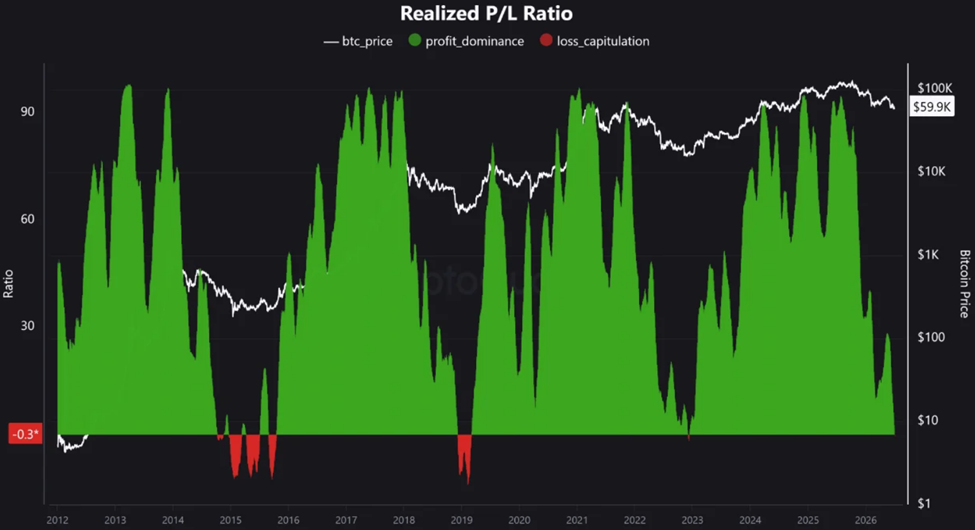
The realized P&L ratio has fallen to one of its lowest readings in more than three years. Bitcoin is trading only modestly above its realized price. Investor sentiment remains fragile, and many retail participants continue to wait for a lower entry point.
Yet history suggests that markets rarely offer clear confirmation before beginning a new trend.
Outlook: Evidence Is Building, but Confirmation Remains Ahead
While no single indicator can guarantee that Bitcoin has reached its ultimate bottom, the convergence of multiple on-chain signals is becoming increasingly difficult to ignore.
CryptoQuant’s realized P&L ratio has entered historically rare territory. Bitcoin continues to trade close to its realized price, long-term holders appear to be accumulating, and institutional inflows are beginning to recover after weeks of weakness.
Taken individually, these metrics may simply reflect a temporary stabilization. Together, however, they resemble the conditions that have preceded several of Bitcoin’s most significant recoveries over the past decade.
The coming weeks will likely determine whether this is merely another relief rally within a broader correction or the foundation of Bitcoin’s next bullish cycle. For long-term investors, the current environment may represent one of those rare periods where the greatest opportunities emerge precisely when market confidence is at its weakest.