
The days when nearly every altcoin surged alongside Bitcoin may be coming to an end. New data suggests that institutional investors are reshaping the crypto market, directing capital into a much smaller group of digital assets and leaving many smaller tokens behind.
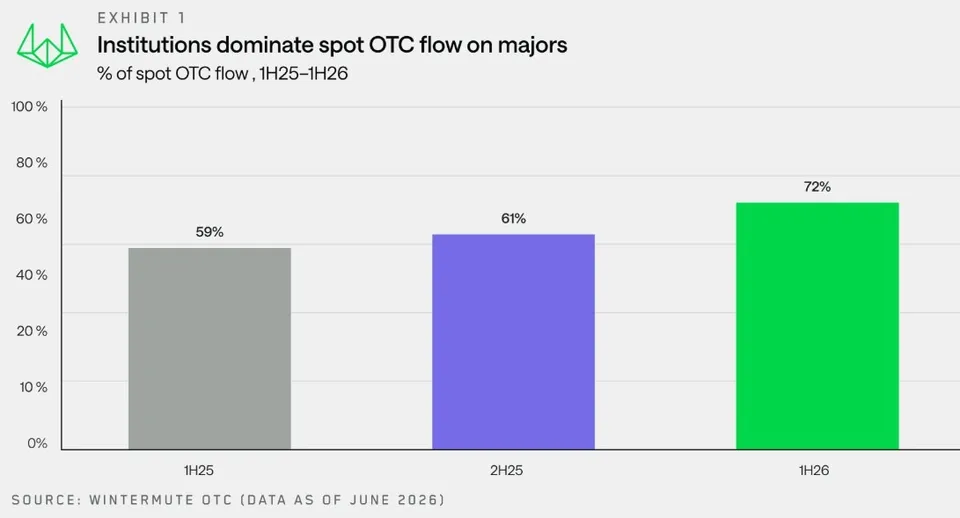
According to crypto market maker Wintermute, institutional investors accounted for 72% of all spot trading activity on its over-the-counter (OTC) desk during the first half of 2026—the highest proportion the firm has ever recorded. The figure represents a sharp increase from 61% in the second half of 2025 and 59% a year earlier, highlighting the growing influence of professional investors on crypto market dynamics.
Unlike retail traders, who often spread capital across a wide range of speculative assets, institutions appear to be concentrating on a select group of cryptocurrencies with stronger liquidity and clearer investment cases. As a result, future altcoin rallies may become increasingly selective rather than lifting the broader market.
Wintermute found that institutional participation is also more disciplined. After a token experiences a sharp increase in price and trading volume, institutional activity typically subsides within a single day. Retail traders, by comparison, tend to continue buying for roughly three days, extending short-term momentum but often increasing volatility.
The firm’s data also reveals a widening gap in market breadth. Since the first half of 2024, the number of unique tokens traded by institutional clients has increased by only 24%, while retail participants expanded their activity across 76% more tokens. This suggests that institutions are becoming more selective even as the number of available cryptocurrencies continues to grow.
The trend extends beyond Wintermute’s proprietary data. Earlier this year, CryptoQuant CEO Ki Young Ju argued that the traditional “altcoin season”—where profits from Bitcoin naturally rotated into smaller cryptocurrencies—has largely disappeared. Trading volume in Bitcoin-denominated altcoin pairs has fallen to its lowest level since 2021, indicating that capital is no longer flowing broadly across the market.
Market concentration has become increasingly apparent in overall valuations as well. The ten largest non-stablecoin altcoins now account for roughly 80.5% of the market capitalization outside Bitcoin and stablecoins, underscoring how investor attention is becoming focused on a limited number of established assets.
Exchange trading data points to the same conclusion. Analytics firm Kaiko reported that the ten largest altcoins represented 63% of all altcoin trading volume by mid-2025, up significantly from around 50% just months earlier. Smaller cryptocurrencies have steadily lost market share as liquidity migrates toward larger, more established projects.
Industry executives believe this shift reflects a maturing digital asset market. DWF Labs managing partner Andrei Grachev recently argued that thousands of tokens are now competing for a finite pool of investment capital. Rather than chasing speculative narratives across the entire market, institutional investors are prioritizing Bitcoin, Ether, and tokenized real-world assets while allocating capital more cautiously to a limited number of altcoins.
For investors hoping for another broad-based altcoin boom, the implications are significant. The next altcoin season may still arrive, but instead of lifting hundreds of cryptocurrencies simultaneously, it could reward only projects with strong liquidity, institutional support, and clearly defined use cases. In an increasingly institution-driven market, selectivity may prove more valuable than diversification across speculative tokens.