
Bitcoin came under renewed selling pressure on Friday, falling toward $60,000 as weakness across US technology stocks spread into the cryptocurrency market. Investors increasingly questioned the sustainability of AI-related valuations following Anthropic’s highly anticipated stock market debut.
Key points:
- Bitcoin declined to $60,000, marking its lowest price level in 20 weeks, as selling pressure intensified across technology shares.
- Anthropic shares reversed their initial IPO gains, dropping from an intraday high of $115 to $87.27 as investor enthusiasm cooled.
- Macroeconomic uncertainty, tighter Federal Reserve policy expectations and concerns over AI-sector financing could continue to limit Bitcoin’s recovery.
Technology stocks extend losses as Anthropic IPO enthusiasm fades
Bitcoin struggled to regain ground following Friday’s Wall Street opening, with TradingView data showing the cryptocurrency hovering around $60,000.
The broader US equity market also remained under pressure. Despite considerable attention surrounding Anthropic’s Nasdaq debut, the company’s initial trading performance failed to generate lasting optimism among investors.
Anthropic shares initially climbed to $115 but subsequently reversed course, falling below their $100 offering threshold and reaching $87.27 during Friday’s session.
The weakness extended across the technology sector. The Nasdaq Composite opened down approximately 1.2%, falling to 23,517 points, its lowest reading since mid-April.
Crypto trading firm QCP Capital noted that even a major IPO from one of the AI industry’s most prominent companies was unable to reverse deteriorating market sentiment.
The firm argued that investors were becoming increasingly cautious about paying elevated valuations for AI-related businesses. Although Anthropic initially traded 34% above its IPO price, its gains narrowed considerably, suggesting that demand was insufficient to sustain the early rally.
Beyond valuation concerns, QCP highlighted the growing financial risks associated with the AI investment boom.
The sector’s enormous infrastructure requirements have made financing conditions increasingly important. As companies rely more heavily on borrowing to fund data centers, computing capacity and other infrastructure, declining investor confidence could translate into higher financing costs.
This creates risks beyond the stock market itself. More expensive borrowing could restrict investment, weaken liquidity and potentially trigger broader reductions in financial exposure.
Federal Reserve uncertainty adds another obstacle for Bitcoin
The deterioration in equity markets coincided with a shift toward safer assets, while US Treasury yields moved lower amid concerns about the economic and financial outlook.
The 10-year Treasury yield declined to approximately 4.96% on Friday, reaching its lowest level since Nov. 10.
However, comments from Federal Reserve officials continued to complicate the outlook for monetary policy.
Federal Reserve Governor Christopher Waller delivered remarks at the 2026 College Fed Challenge in Washington, D.C., but provided no meaningful new guidance regarding the central bank’s future decisions.
Investors instead continued to assess his earlier comments suggesting that a 50-basis-point interest rate increase in December might be necessary. Such an adjustment would be twice the 25-basis-point increase currently anticipated by markets.
Economist Mohamed El-Erian also pointed to an unusual feature of the recent market reaction: Treasury yields had declined relatively modestly despite substantial losses in equities.
He observed that the 10-year yield had retreated to around 4.97% following a difficult week for stocks, during which the S&P 500 was approaching a potential seventh consecutive session of losses — a streak not seen since 2020.
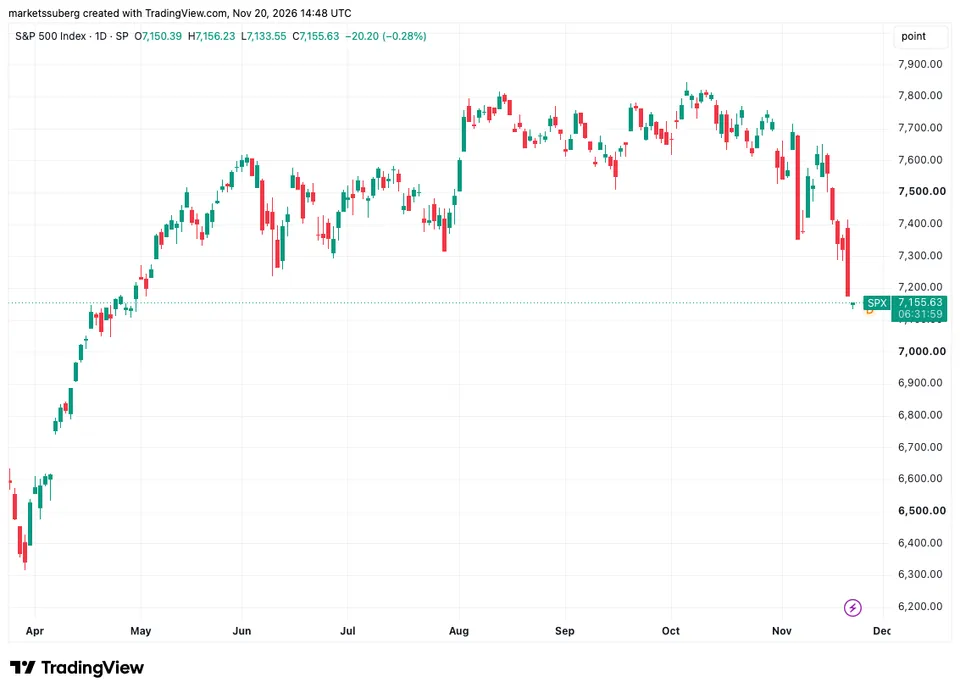
In his assessment, although the direction of the bond market movement was consistent with conventional market relationships, the limited magnitude of the decline was noteworthy.
For Bitcoin, the combination of equity-market weakness and uncertainty surrounding monetary policy creates an unfavorable environment for a sustained recovery.
QCP Capital suggested that a meaningful improvement in Bitcoin’s outlook would likely require several conditions to align: stabilization in technology stocks, lower interest-rate volatility and renewed participation from institutional investors.
Until those factors improve, any upward movement in BTC could remain vulnerable to short-covering rather than develop into a broader recovery, particularly if the Federal Reserve maintains a restrictive policy stance.