

A wrapped version of Monero suffered a near-total collapse on Hyperliquid after a wallet linked to the token’s deployer account sold approximately $13.5 million worth of tokens. The incident triggered concerns about a possible private-key compromise, while the service operator behind the asset pledged to compensate affected traders.
The token, XMR1, dropped from roughly $500 to $1 in about 30 minutes on Friday, representing a decline of approximately 99.8%, according to blockchain analytics firm Bitquery.
The sell-off affected XMR1, not Monero’s native cryptocurrency (XMR). Wrapped tokens are designed to represent assets from other blockchain networks, allowing them to circulate and trade in different ecosystems.
Onchain investigation traces $13.5 million in sales
Bitquery’s investigation identified a wallet that received 5.2 million XMR1 tokens from the deployer account before selling approximately $13.5 million worth of the asset.
The analytics firm tracked around $13.28 million in USDC transferred to Arbitrum. Of that amount, approximately $13.22 million was converted into 7,467 Ether (ETH) through CoW Protocol. Most of the resulting ETH was subsequently bridged to Ethereum.
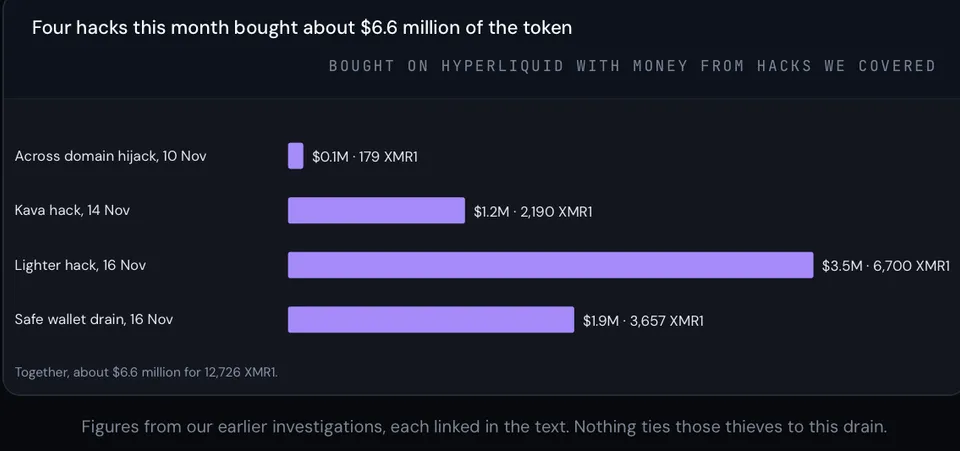
Bitquery also identified earlier purchases of XMR1 involving funds associated with four separate security incidents reported in November. Those incidents involved Across Protocol, Kava, Lighter and Safe.
According to the firm’s analysis, approximately $6.6 million worth of XMR1 had been purchased using proceeds from those incidents, apparently as a way to obtain native Monero exposure.
However, Bitquery emphasized that it found no onchain evidence connecting the four earlier hacks to Friday’s suspected exploit.
The investigation also could not determine how the deployer account’s private key was obtained or identify who controlled it during the transactions. As a result, the precise mechanism behind the suspected compromise remains unclear.
Wagyu operator alleges hosting provider breach
PerpetualCow, the pseudonymous operator of Wagyu, the service behind XMR1, attributed the incident to an alleged security breach involving hosting provider 1984.
The operator claimed that the incident exposed customer information and internal server files. PerpetualCow also said the XMR1 deployer key had been stored on a server that was later deleted, but alleged that the hosting provider retained associated logs and files.
These claims have not independently established how the wallet was accessed or who carried out the transactions.
Operator promises reimbursement and a possible relaunch
PerpetualCow said they would personally reimburse traders affected by the collapse and indicated that Wagyu could return at a later date.
The operator did not provide a specific timetable for either the compensation process or the service’s potential relaunch.
Cointelegraph contacted PerpetualCow for further information about the alleged breach and the proposed reimbursement arrangements, but had not received a response by publication.
For now, the incident leaves two key questions unresolved: how control of the deployer wallet was allegedly compromised and how affected XMR1 holders will be compensated.

