
Why the Next Wallet Drain May Start With a Search Bar
For years, cryptocurrency security has revolved around a familiar set of rules: protect your seed phrase, use a hardware wallet, enable two-factor authentication, and avoid suspicious links.
Yet a growing number of attacks are bypassing those defenses entirely.
The latest threat is not targeting private keys or exploiting blockchain vulnerabilities. Instead, it is exploiting something far more common: user trust in search engines.
Recent phishing campaigns impersonating major crypto platforms such as Uniswap have highlighted a troubling reality. Search engines, once viewed as neutral gateways to information, are increasingly becoming part of the attack surface for cryptocurrency scams.
In today’s environment, a wallet compromise may begin long before a user connects to a malicious website. It may start with a simple Google search and a single misplaced click.
The Evolution of Crypto Fraud
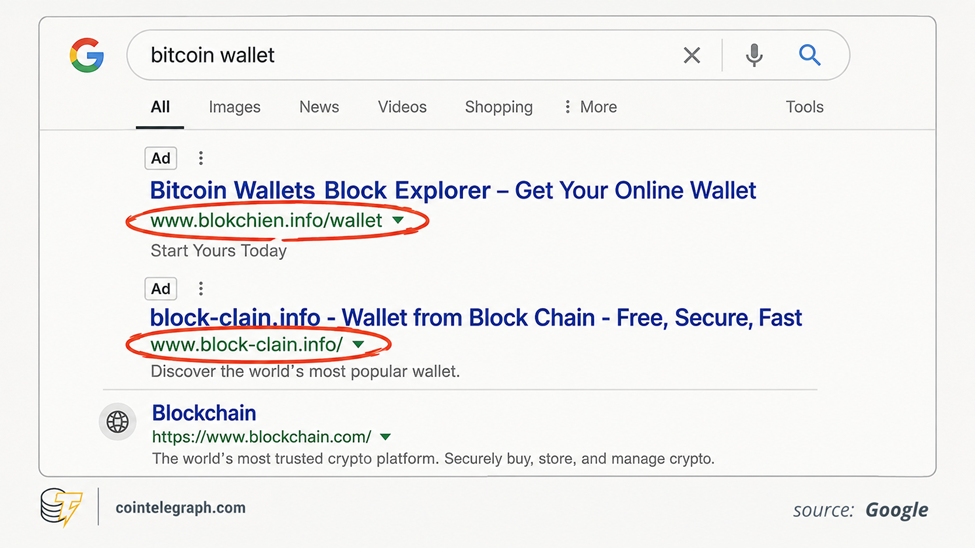
Traditional cybercrime typically focused on technical weaknesses. Hackers searched for software vulnerabilities, malware distribution channels, or compromised servers.
Modern crypto scams operate differently.
Rather than attacking systems, attackers increasingly attack behavior.
The cryptocurrency industry has matured to the point where major protocols, exchanges, and wallets have invested heavily in technical security. As a result, criminals have shifted their focus toward the weakest link in the ecosystem: human decision-making.
Search engines provide an ideal opportunity.
Millions of users search daily for terms such as “MetaMask,” “Uniswap,” “Ledger Live,” or “Phantom Wallet.” These searches reveal intent. The user is already looking to download software, connect a wallet, or execute a transaction.
For scammers, there is no need to create demand. The target has already identified themselves.
The Uniswap Phishing Campaign Reveals a New Attack Model
A recent attack involving fake Google advertisements demonstrated just how effective this strategy has become.
Reports indicate that attackers stole at least $400,000 after placing fraudulent advertisements that impersonated the decentralized exchange Uniswap.
The mechanics were surprisingly simple.
Users searching for Uniswap were shown a sponsored result that appeared nearly identical to the official platform. The branding looked authentic, the messaging appeared legitimate, and the placement near the top of search results created an additional sense of trust.
Once users clicked the advertisement, they were redirected to a highly convincing clone of the Uniswap interface.
From there, everything seemed normal.
Victims connected their wallets, approved transactions, and interacted with what appeared to be a legitimate DeFi application. Only later did they discover that the permissions they had signed allowed attackers to drain assets directly from their wallets.
What makes these attacks particularly dangerous is that no private keys were stolen.
No malware was installed.
No encryption was broken.
The victims themselves unknowingly authorized the transactions.
This represents a significant shift in the threat landscape. The attack succeeds not by defeating cryptography, but by manipulating trust.
Why Experienced Crypto Users Are Still Getting Tricked
A common misconception is that phishing attacks primarily affect newcomers.
Reality tells a different story.
Even veteran crypto traders can become victims under the right circumstances.
One explanation is authority bias. Users naturally place greater trust in systems they interact with every day. Google has spent decades building a reputation as one of the internet’s most reliable gateways to information.
When users see a result at the top of a search page, many unconsciously interpret that position as a form of verification.
Unfortunately, search ranking is not the same as trustworthiness.
Speed also plays a role.
The modern DeFi ecosystem encourages rapid decision-making. Traders move between bridges, staking protocols, liquidity pools, and decentralized exchanges within minutes. During periods of market volatility, speed often becomes a priority.
Attackers understand this behavior.
Their goal is not to create a perfect imitation. It is simply to create a convincing enough experience that users stop paying attention to details.
Even a highly experienced investor can make mistakes when distracted, rushed, or focused on market opportunities.
Hardware Wallets Cannot Solve This Problem Alone
Hardware wallets remain one of the most effective security tools available to crypto investors.
However, recent phishing campaigns expose a critical limitation.
A hardware wallet can verify that a transaction is being signed.
It cannot always determine whether signing that transaction is a good idea.
This distinction is becoming increasingly important.
Many users still view hardware wallets as a complete security solution. In reality, they are only one layer of protection.
If a user willingly signs a malicious approval request through a fake interface, the hardware wallet may faithfully execute the instruction because, from a technical perspective, the transaction appears valid.
The device protects private keys.
It does not protect judgment.
As social engineering becomes more sophisticated, this distinction may define the next generation of crypto security challenges.
Search Engines Have Become a High-Value Target
Search advertising offers criminals a combination of scale, precision, and efficiency that few other attack channels can match.
Unlike phishing emails, which may be filtered or ignored, search ads appear precisely when users are looking for a destination.
The timing is perfect.
The victim is already motivated to act.
Additionally, fraudulent campaigns are easy to rebuild. When one malicious domain is removed, attackers can quickly launch another using new advertising accounts, fresh domains, or slight variations of existing brands.
This creates an asymmetric battle.
Defenders must stop every malicious campaign.
Attackers only need one successful click.
The Problem Extends Beyond Google
While Google search advertisements have received significant attention, the issue is far broader than a single platform.
Reddit users frequently report encountering fraudulent crypto advertisements alongside legitimate discussions.
YouTube continues to battle fake livestreams impersonating major crypto projects and promising unrealistic giveaways.
Telegram communities remain flooded with fake support representatives attempting to trick users into revealing wallet information.
Across all platforms, the pattern remains remarkably consistent.
Systems designed to maximize visibility and engagement can also amplify fraud.
As cryptocurrency adoption grows, scammers increasingly follow user attention rather than technological vulnerabilities.
The Rise of SEO Poisoning
Avoiding sponsored advertisements is no longer sufficient.
Attackers have evolved.
SEO poisoning has become one of the fastest-growing threats in the cryptocurrency space. Instead of purchasing advertisements, attackers manipulate search rankings to place malicious websites near the top of organic search results.
Some acquire expired domains with strong authority.
Others publish large volumes of content specifically designed to rank for high-value crypto keywords.
Typosquatting has also become increasingly common, with scammers registering domains that differ from legitimate websites by only a single character.
In many cases, even security-conscious users struggle to identify the difference.
This means the search results themselves can no longer be assumed to be safe.
The Industry’s Next Security Challenge
The crypto industry often frames security as a technical problem.
Increasingly, it is becoming a user experience problem.
Most major losses today are not caused by broken cryptography or protocol exploits. They result from carefully crafted experiences designed to appear legitimate.
The attack path is surprisingly simple:
Search → Click → Connect Wallet → Approve Transaction → Lose Funds.
Every step feels familiar.
That familiarity is precisely what attackers exploit.
As cryptocurrency continues moving toward mainstream adoption, security solutions must evolve beyond protecting private keys. The next frontier will involve reducing confusion, improving transaction transparency, and helping users distinguish legitimate experiences from fraudulent ones.
The Bottom Line
The greatest threat to crypto users is no longer necessarily a hacker breaking into a wallet.
It may be a scammer purchasing an advertisement, manipulating a search ranking, or creating a near-perfect copy of a trusted platform.
For investors, the lesson is becoming increasingly clear: security begins before the wallet connection screen appears.
In an era where search engines have become part of the attack surface, the safest click may be the one that never comes from a search result at all.