A solo Bitcoin miner has beaten extraordinary odds by successfully validating a block with a low-cost Bitaxe mining rig, earning the full 3.125 BTC block reward worth roughly $200,000.
The block was confirmed at height 957382 on Friday, according to blockchain data from mempool.space. Unlike industrial mining operations that rely on thousands of ASIC machines, the miner reportedly used a single Bitaxe device through Public Pool, making the achievement one of the rarest outcomes in Bitcoin mining.
A Rare Victory for Retail Miners
The Bitaxe is an open-source Bitcoin miner that costs less than $200 and delivers around 1 terahash per second (TH/s) of computing power—a negligible share of the Bitcoin network’s total hashrate, which is measured in exahashes per second.
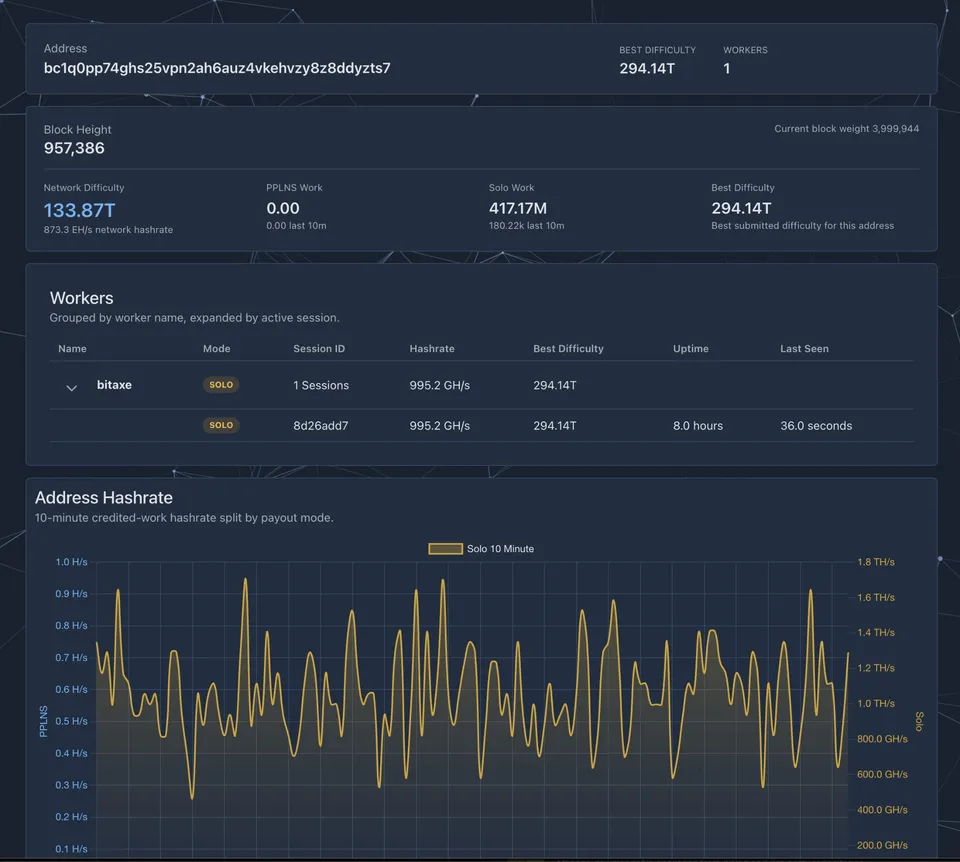
Given its limited processing power, the probability of independently discovering a valid Bitcoin block is extremely small. However, Bitcoin’s proof-of-work mechanism gives every miner a chance to solve the next block, regardless of the size of their operation.
The latest success serves as a reminder that while industrial mining firms dominate the network, hobby miners can still occasionally secure the entire block reward through solo mining.
Solo Mining Wins Continue to Surprise
This is not the first time an individual miner has stunned the Bitcoin community in 2026.
In April, another solo miner successfully validated a Bitcoin block through CKPool’s solo mining service. Earlier in February, a retail participant also mined a block independently after renting hashrate from a mining provider rather than operating physical hardware.
These events remain exceptionally uncommon but demonstrate that solo mining victories continue to occur despite Bitcoin’s record-high mining difficulty.
Hobby Miners Have Earned $4.7 Million Over the Past Year
The latest payout marks the 12th solo block mined by a hobby-level Bitcoin miner in 2026, according to data from solo mining tracker Bennet.
Over the past 12 months, retail miners have successfully validated 24 solo blocks, a 41% increase compared with the previous year. Combined, those blocks have generated 75.4 BTC, worth approximately $4.7 million at current market prices.
Data also shows that solo miners discover a successful block every 15.2 days on average, although the longest stretch without a solo mining success reached 58 days, highlighting the unpredictable nature of Bitcoin mining rewards.
A Statistical Long Shot, Not a New Trend
While the latest $200,000 payout may inspire more retail miners to try their luck, the economics of solo mining remain unchanged.
A single Bitaxe contributes only a tiny fraction of the Bitcoin network’s total computing power, meaning the chances of repeating such a success remain extremely low. For most participants, joining a mining pool continues to provide far more consistent—albeit smaller—rewards.
Still, the latest block serves as another example that Bitcoin’s mining network remains open to participants of all sizes. Even as industrial miners control the vast majority of global hashrate, individual hobbyists continue to prove that extraordinary wins, while rare, are still possible.