
Stablecoin markets have experienced approximately $12 billion in net redemptions over the 30 days leading up to Nov. 13, suggesting that investors are withdrawing capital from the cryptocurrency ecosystem rather than simply moving funds between digital assets.
Crypto research firm Kaiko identified the contraction across 11 major stablecoins, drawing comparisons with liquidity conditions during the 2022 bear market. However, analysts noted that the latest withdrawal wave has been considerably smaller and appears to be losing momentum.
Tether’s USDt (USDT) and Circle’s USDC, the two largest stablecoins by market capitalization, each recorded an approximately 4% decline in circulating supply during the period. Since Nov. 13, however, overall stablecoin supply has decreased by only 0.4%, while USDC has begun recording modest growth.
Kaiko analyst Andrew Yang told Cointelegraph that the contraction indicates capital is leaving the crypto market instead of shifting between different cryptocurrencies. This has reduced the amount of stablecoin liquidity available to traders looking to purchase digital assets.
The withdrawals have occurred alongside sustained outflows from US spot Bitcoin exchange-traded funds and growing expectations that the Federal Reserve could maintain a tighter monetary policy.
USDT trading activity weakens despite strong blockchain transfers
The decline in stablecoin liquidity has also affected trading activity. Kaiko data shows that daily trading volumes across USDT pairs during the past month were approximately half their 2025 average.
Bitcoin market makers have continued providing liquidity near prevailing market prices, although the overall dollar value of buy and sell orders within 1% of Bitcoin’s spot price declined by roughly 15% over the same period.
Interestingly, when measured in BTC rather than dollars, the combined size of those orders increased by 9%, according to Yang.
Ethereum accounted for nearly 90% of the total stablecoin supply reduction over the 30-day period. The network serves as a major settlement layer for cryptocurrency exchanges and decentralized finance applications. By comparison, stablecoin supply on Tron, which is widely used for payment transfers, declined by just 1.4%.
Despite the contraction in circulating supply, onchain activity remains relatively strong. Transfers involving USDT and USDC have averaged approximately $157 billion per day so far this quarter, exceeding the 2025 average of $130 billion. However, the figure remains below the transaction pace recorded during the fourth quarter of last year.
Current stablecoin withdrawals remain below 2022 levels
Kaiko’s Yang said the current liquidity reduction resembles the conditions seen during the 2022–2023 bear market, when rising interest rates and declining cryptocurrency prices triggered prolonged redemptions from fiat-backed stablecoins.
Nevertheless, he characterized the latest downturn as substantially less severe. Stablecoin supply also experienced a contraction between mid-May and June this year before stabilizing in August.
Julio Moreno, head of research at blockchain analytics firm CryptoQuant, noted that USDT is experiencing its largest supply decline since 2022. Its market capitalization has decreased by approximately $9 billion over the past 60 days, reflecting broader investor withdrawals from risk-sensitive markets, including equities and commodities.
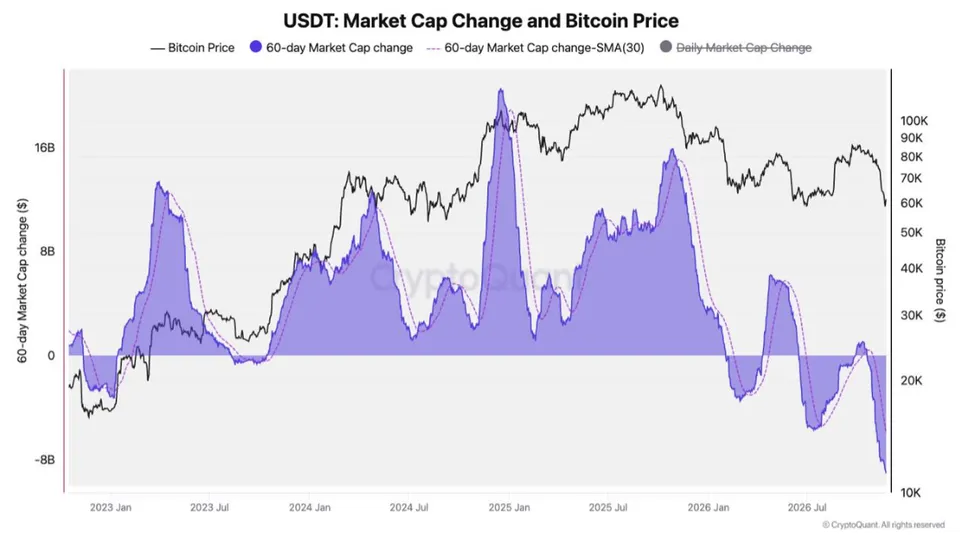
Moreno considers USDT supply an important indicator of available trading liquidity. He also noted that cryptocurrency exchanges hold approximately 51% of the USDT circulating on Ethereum.
An additional historical parallel emerged in November 2022, when USDT supply was also declining around the time Bitcoin reached its market bottom.
However, Moreno emphasized that the recovery of cryptocurrency markets will likely require stablecoin liquidity to expand again. In his view, renewed growth in stablecoin supply is necessary to improve market liquidity and support a broader recovery in digital asset prices.